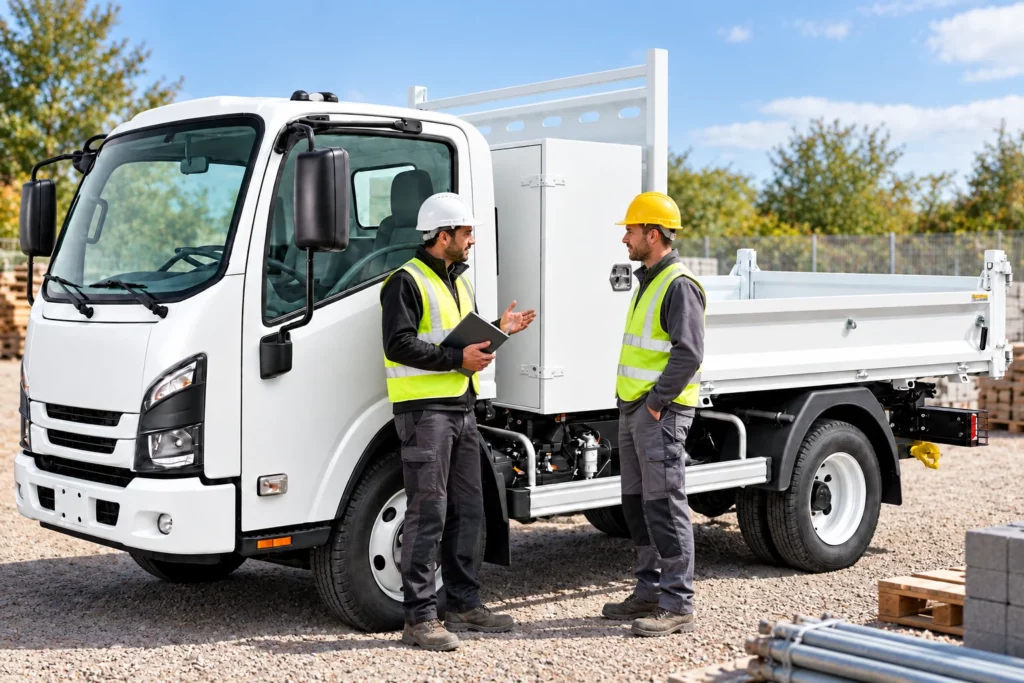
For a builder, the right 3.5 tonne tipper truck is the one that carries what you actually load, without exceeding its gross vehicle weight, and that stands up to rubble day after day. The choice is therefore not made from a brochure: it is made from your working days on site, the weight of your materials, and the room you need to keep for the crew and the tools. Here is a five-step method, illustrated with an example.
1. Describe a day on site
Take a fictitious example: a three-person building firm working on renovations and small extensions.
A typical day:
- in the morning, leaving the yard with the crew, a cement mixer, the tools and a few bags of cement;
- a stop at the builders’ merchant to load sand or gravel;
- on site, clearing demolition rubble;
- at the end of the day, tipping the rubble at an authorised waste site or recycling facility.
Describe yours in the same way. That is what defines the need, not the data sheet.
2. Work out the payload you need
Three ideas not to be confused:
- the capacity of the body: the volume it can hold;
- the payload: the weight the vehicle can still carry without exceeding its gross vehicle weight (GVW);
- fitness for use: what the tipper body is designed to withstand (impacts, abrasion, bucket loading).
On a truck with a GVW of 3.5 tonnes, the payload is worked out like this: GVW minus the weight of the chassis cab, the tipper body, the occupants, the fuel and the tools on board. What remains is the weight of materials you can load. The Road Vehicles (Construction and Use) Regulations 1986 prohibit using a vehicle on a road if any of the weights shown on its plate, the GVW or the weight on an axle, is reached or exceeded (regulation 80).
Watch out for dense materials: a few barrows of wet rubble or a pallet of concrete blocks can use up all the remaining payload long before the body is full. A « standard » pallet has no standard weight: weigh it or read the supplier’s label. For details of the calculation, see our article on the payload of a 3.5 tonne tipper truck.
3. Choose the body and its access
For building work, the body must first be able to take:
- a thick floor, which withstands rubble thrown in with a shovel and the abrasion of sand;
- stiff dropsides, which do not deform under the pressure of loose material;
- a versatile rear door, which opens for tipping and for loading by hand;
- dropsides that fold down for loading a pallet or bags from the side.
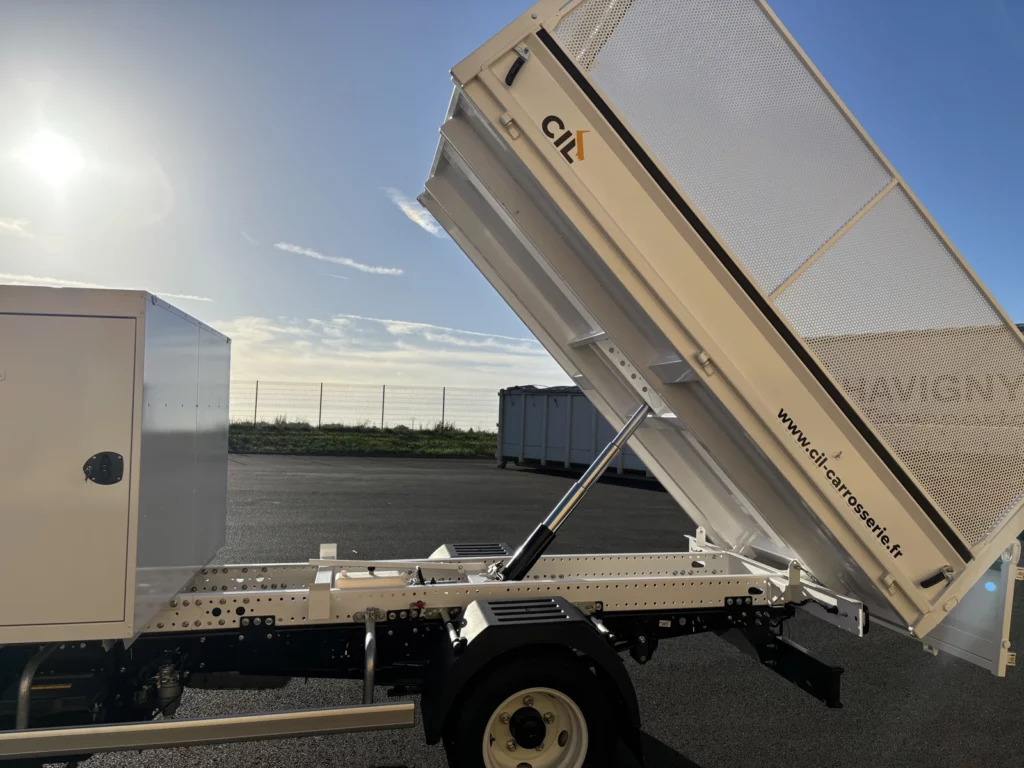
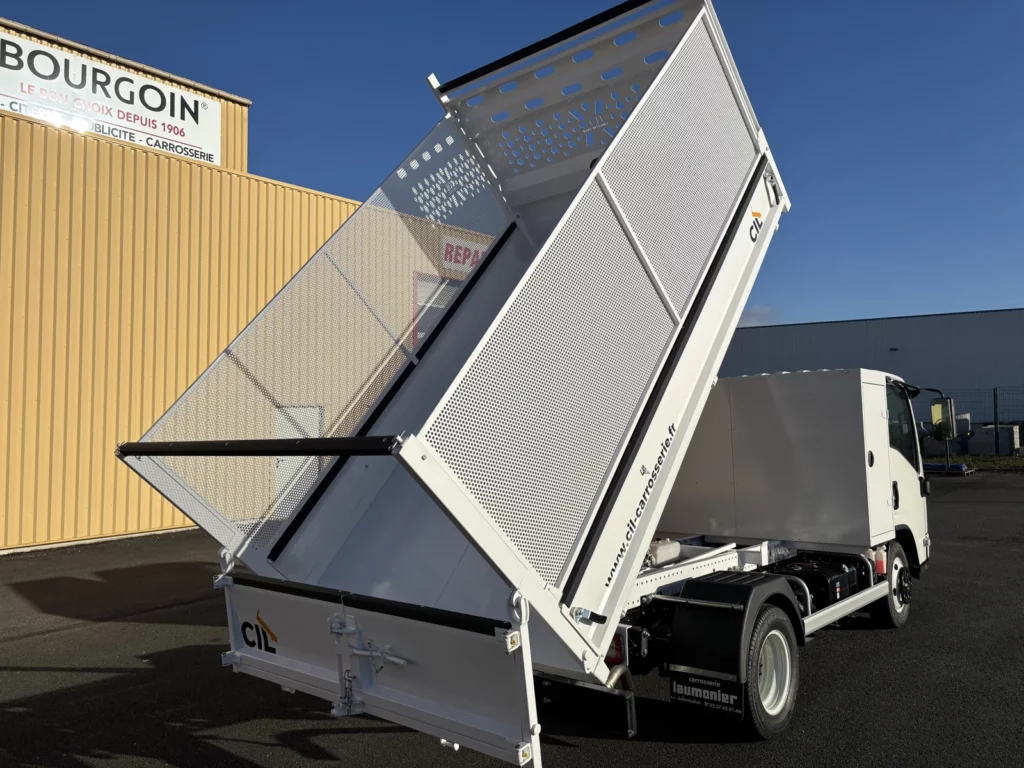
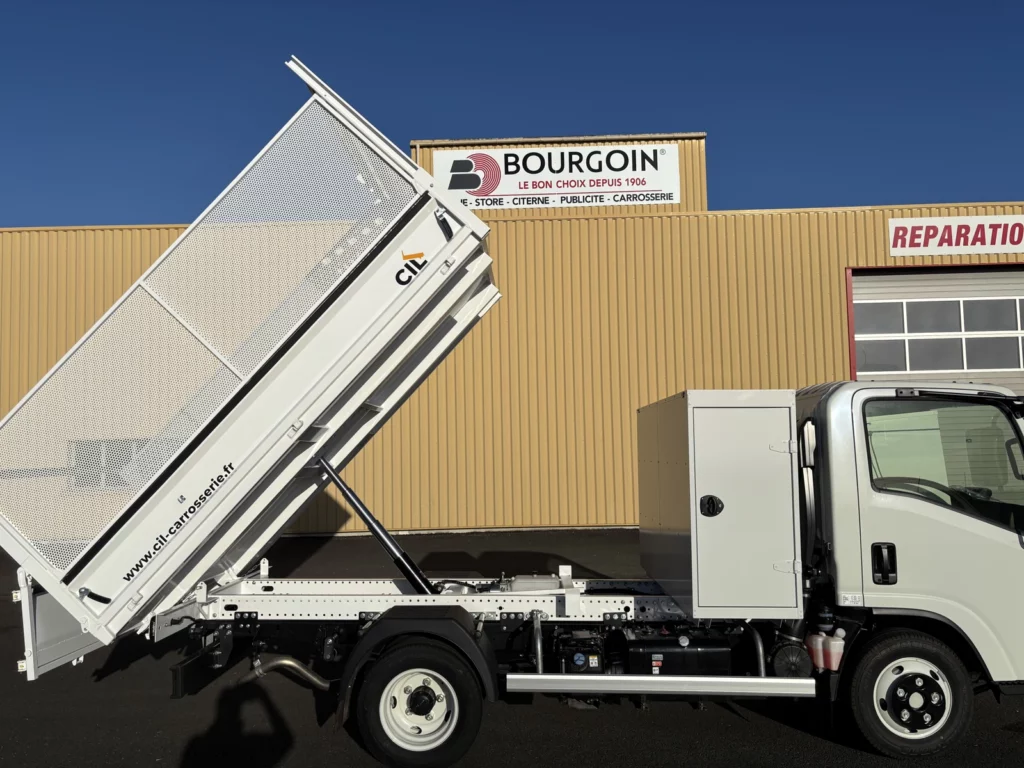
The CIL 3.5 t tipper was designed for this work: a 3 mm steel floor on a genuine tubular frame, steel dropsides folded with closed folds and 3 mm reinforcing angles, a universal rear door, a 47.7° tipping angle and a 3-stage telescopic cylinder. Its unladen weight and dimensions are given on its data sheet.
For the choice of body material, see our article on steel and aluminium tipper bodies.
4. Plan for tools and a trailer
A builder’s tools take up space and weigh a lot: cement mixer, props, laser level, small equipment. Where do you put them?
- Behind-cab toolbox or in-body toolbox for tools under lock and key;
- ladder rack for ladders and long lengths;
- tool holder tailored to your equipment.
These options are to be confirmed in the quote according to your configuration.
A trailer can complement the truck for a mini digger or a cement mixer. It can change the licence you need depending on the weights involved: check your case before hitching up with our licence simulator.
Finally, the load must be held in place: regulation 100 of the Road Vehicles (Construction and Use) Regulations 1986 requires the load to be secured so that neither danger nor nuisance is likely to be caused.
5. Compare proposals on the same basis
To compare quotes, ask each supplier for:
| Item | Why |
|---|---|
| What is being sold: tipper body only, fitted, or complete truck | Compare like with like |
| Weight of the complete, equipped tipper body | Work out the real payload |
| Internal body dimensions | Compare volumes |
| Floor and dropside thicknesses | Judge strength |
| Options included and compatibility with your chassis | Avoid surprises at fitting |
| Written warranty and lead time | Plan ahead |
Describe your work, your crew, your materials and your chassis: ask CIL for a quote for your tipper project. Ask for a quote for my tipper project
Frequently asked questions
What payload does a builder need?
It depends on the chassis, the tipper body and what you carry all the time. Do the calculation from the vehicle’s plate and documents and from actual weights, then compare it with the weight of your typical loads.
Can you load a pallet of concrete blocks in a 3.5 t tipper?
Only if its weight stays within the payload available that day, taking the crew and the tools into account. Weigh it or read the supplier’s label.
Do you need a thick floor for rubble?
Rubble wears and dents the floor. A thick steel floor, on a strong frame, stands up better to daily use.
Can you buy the complete truck from CIL?
Give details of your project in your request: a tipper body to fit on your chassis or a vehicle to be equipped. CIL will tell you what is possible for your configuration.
A project? Need a  tipper? A question?
Write to us or call us: we will get back to you quickly.
Request a quote