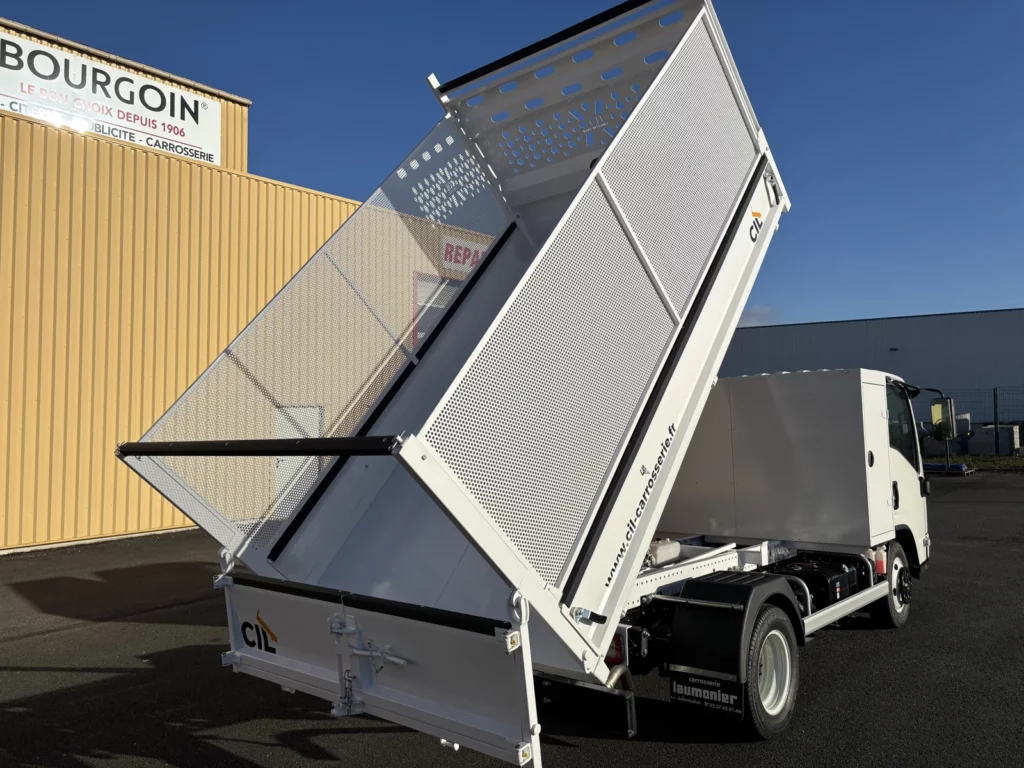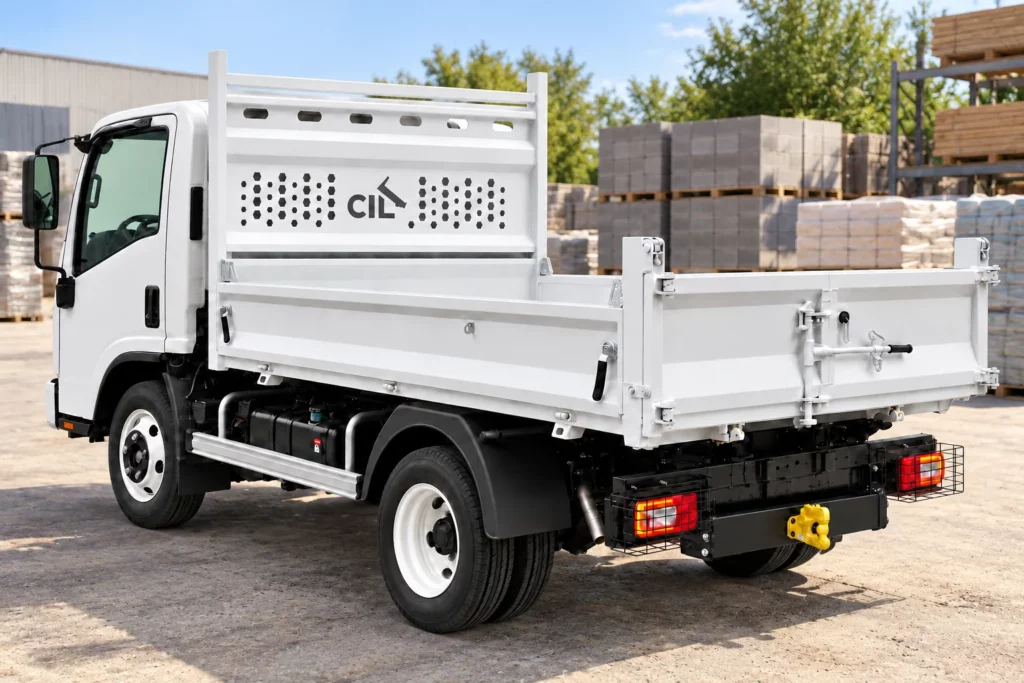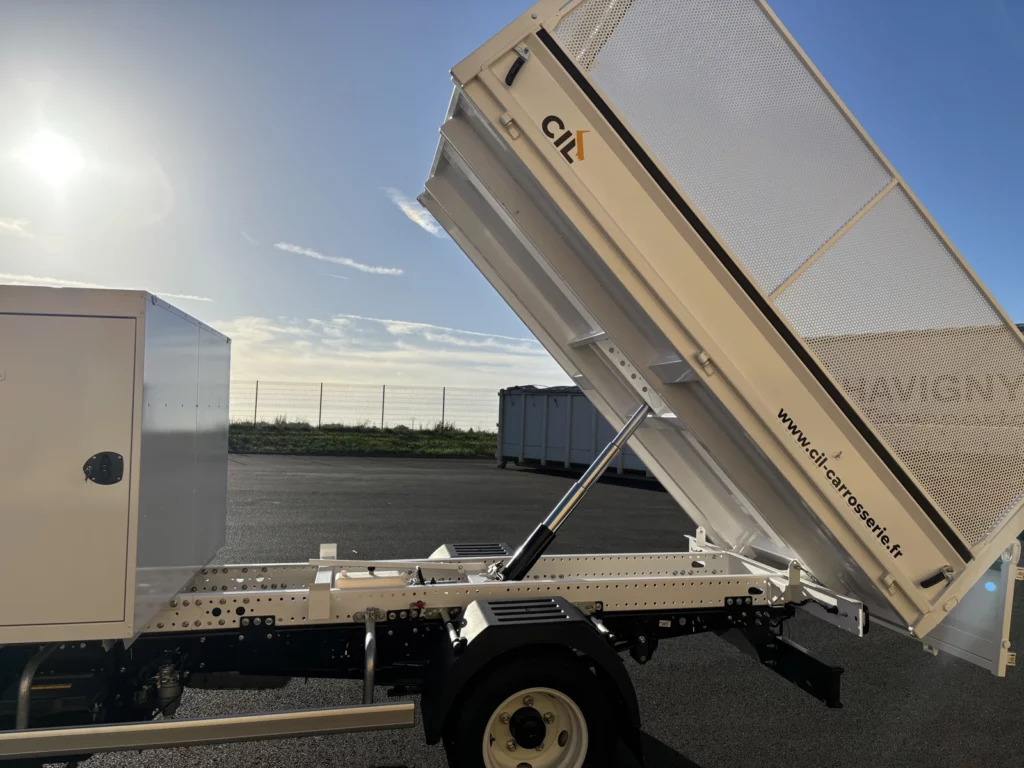
You press the control and the body does not move, or barely. First reflex: stop, do not persist and make the area safe. Then, a few observations made without dismantling anything and without going under the tipper often point the way forward: a simple operating condition to correct, or a job for a professional. These observations are not a diagnosis, but they save everyone time.
1. Stop and make safe
- Release the control. Persisting will not lift a stuck tipper; it overheats the power pack motor, drains the battery and can make a fault worse.
- Keep people away from the rear and sides of the truck.
- If the body is partly raised and loaded, or seems unstable, do not stand under it or behind it. Call in a professional.
- Never go under a raised body that is not held by the mechanical device provided for this purpose, such as a safety prop, as set out in the instructions.
2. What can you see and hear?
The table below helps you describe what is happening. It points the way, it does not diagnose.
| What you notice | What you can observe without dismantling | Next step |
|---|---|---|
| No noise, nothing happens | Vehicle ignition and operating conditions set out in the instructions; apparent state of charge of the battery; warning lights | If everything is in order: electrical check by a professional |
| The power pack motor runs, the tipper does not move | Load in the body; visible trace of oil; level if the instructions provide for a user check | Do not persist. Remove some of the load if this can be done without risk, otherwise call a professional |
| The tipper lifts in jerks or very slowly | Load, battery, pump noise | Stop, lower if possible, have it checked |
| Visible oil leak | Approximate location, without touching | Stop using the tipper, professional repair |
| The body lowers by itself | Position of the body, people nearby | Keep everyone away, professional repair |
3. User checks set out in the instructions
What the user can check depends on the instructions for the tipper. In general, this means:
- the start-up procedure: ignition, control, any switch or safety device set out in the instructions;
- the load: an overloaded body, or a load stuck right at the top, can prevent it from lifting. The power pack pressure is limited to protect the circuit: beyond that, the tipper does not lift;
- the battery: an electric power pack needs enough voltage;
- the oil level, only if the instructions provide for this check by the user, with the body in the position they specify.
The steps of a visual check of the power pack are set out in our article on checking the hydraulic power pack.
4. What not to do
Some « tricks » turn a breakdown into an accident:
- persisting when overloaded by keeping the control pressed;
- replacing a fuse with a higher-rated one;
- bypassing a safety device or wiring the power pack directly;
- adjusting the pressure relief valve to « force » it to lift;
- shaking the truck or climbing into the body to free the load;
- undoing a fitting on a circuit that may be under pressure.
The pressure relief valve and the electrical protection are there to protect the equipment and people. Getting round them shifts the problem to a more serious risk.
5. Signs that call for a repair
Call in a professional, without using the tipper again, in the event of:
- an active oil leak or a damaged hose;
- a body that lowers by itself or stays stuck in the raised position;
- abnormal pump noise, a smell of burning;
- a fault that comes back after restarting.
6. What information should you pass on?
The more precise your description, the quicker the repair. Prepare:
- the reference of the tipper and the vehicle (registration, make, model);
- the circumstances: first tip of the day, after a long journey, in cold weather;
- the estimated load in the body when the fault occurred;
- what you saw and heard (use the table above);
- a photo taken from a safe position, without going under the tipper.
A tipper designed to last
The CIL 3.5 t tipper uses a 3-stage telescopic cylinder and a 12 or 24 V power pack set at 200 bar, with 30 mm solid pivot pins and accessible greasing points.
Your CIL tipper won’t lift, or you have a question about your equipment? Contact CIL about my equipment
Frequently asked questions
Why does the tipper lift when empty but not when loaded?
The load may be too heavy or badly distributed, for example stuck at the top of the body. The pressure relief valve then stops it lifting to protect the circuit. Remove some of the load if this can be done without risk, otherwise call in a professional.
Can the cold make a difference?
Cold reduces battery performance and makes the oil thicker. If the problem mainly appears in the morning in cold weather, tell the professional.
Can I keep driving with a broken-down tipper?
Only if the body is fully lowered, resting on its supports, and the door and dropsides are locked. A body stuck in the raised position is not driven.
Can I top up the oil myself?
Only if the instructions provide for the user to top up, with the oil they specify. A drop in level often means a leak: it must be traced by a professional.
Updated 25 October 2026
A project? Need a  tipper? A question?
Write to us or call us: we will get back to you quickly.
Request a quote