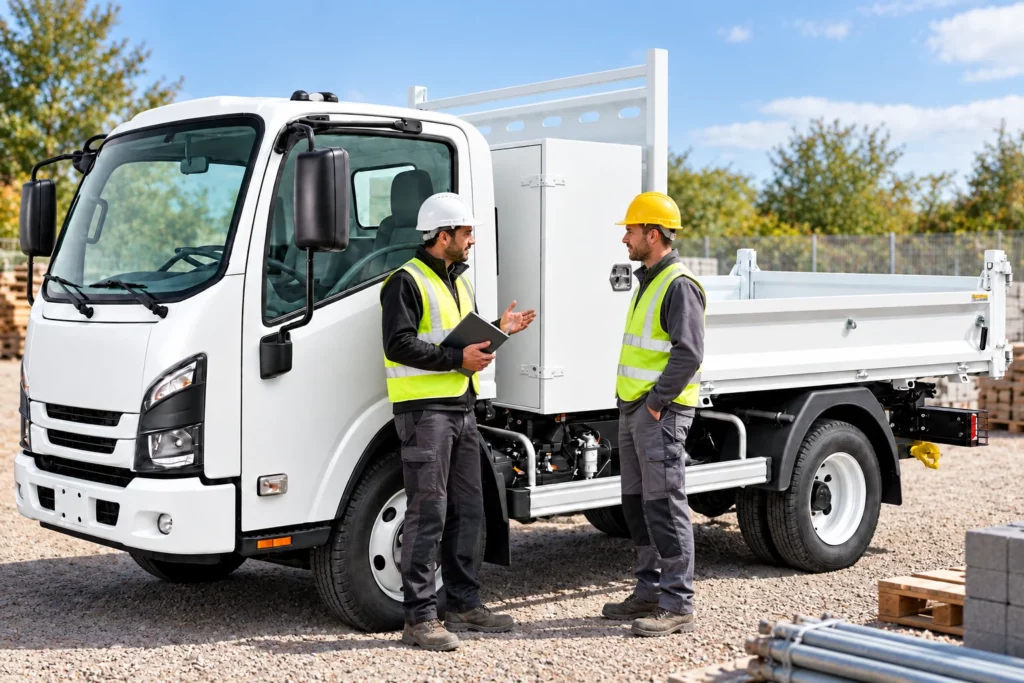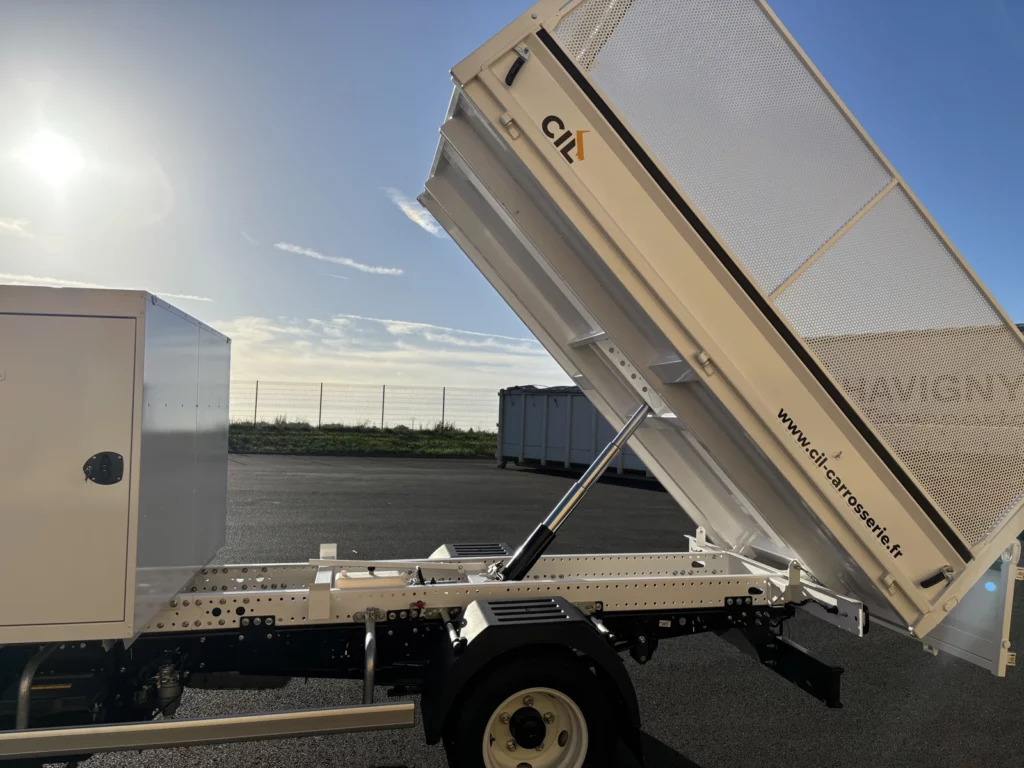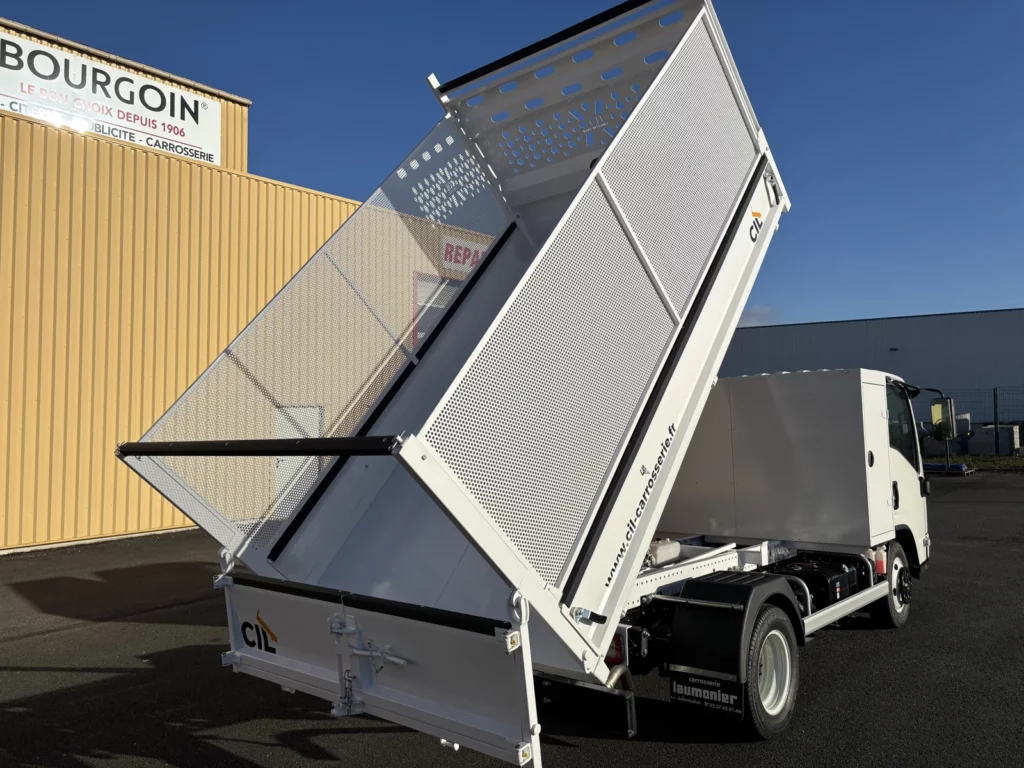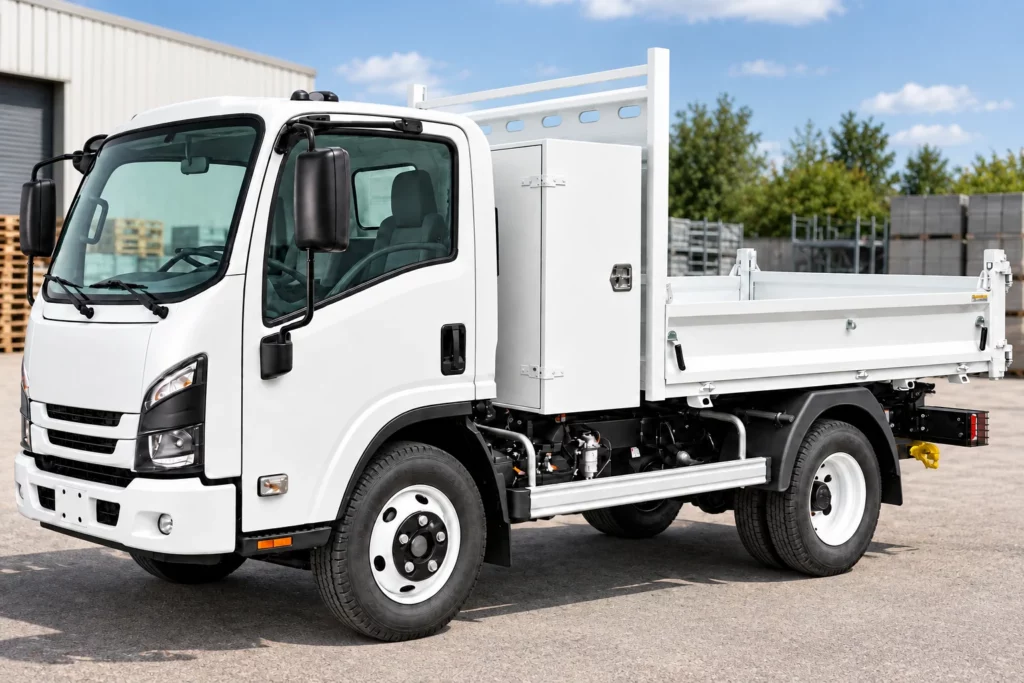
The choice between a single and a double cab starts with one question: how many people travel with the truck, and how often? A double cab carries a full crew, but it weighs more and makes the vehicle longer, which can reduce the body length or the payload available. A single cab leaves more room for the load. The right choice is made on the vehicle as actually configured, not on a general rule.
1. How many people and which journeys?
Start from your typical days:
- You work alone or as a pair: a single cab is usually enough. It generally has two or three seats depending on the model.
- You take a crew of three to six people: a double cab saves a second vehicle for the journeys to site.
- The crew varies from job to job: compare the cost of an occasional extra vehicle with the loss of payload every day.
The number of seats allowed is the number approved for the vehicle and shown in its documents, driver included. Nobody travels in the tipper body: it is made for the load, not for passengers.
2. Compare the remaining capacity
On a truck with a gross vehicle weight (GVW) of 3.5 tonnes, everything on board counts: the chassis cab, the tipper body, the occupants, the tools and the load. The Road Vehicles (Construction and Use) Regulations 1986 prohibit using a vehicle on a road if any of the weights shown on its plate, the GVW or the weight on an axle, is reached or exceeded (regulation 80).
A double cab adds the weight of its structure, its seats and its occupants. There is no universal « loss » figure: it depends on the chassis model. To compare, do the calculation for each configuration:
| Single cab | Double cab | |
|---|---|---|
| GVW (vehicle plate) | 3,500 kg | 3,500 kg |
| Unladen weight of the chassis cab | depends on the model | depends on the model |
| Weight of the equipped tipper body | as per the quote | as per the quote |
| Occupants (allow about 75 kg per person) | 2 × 75 kg | 5 × 75 kg |
| Tools carried at all times | to be estimated | to be estimated |
| What is left for the load | to be calculated | to be calculated |
The weights of the chassis cab are given in its documents. The weight of the tipper body should be requested in the quote. For details of the payload calculation, see our article on the payload of a 3.5 tonne tipper truck.
3. Body length and manoeuvring
With the same wheelbase, a double cab takes up room on the chassis: the body available is shorter. To keep a long body, you need a longer wheelbase, and therefore a bigger vehicle:
- harder to manoeuvre in town centres or in a narrow yard;
- trickier to position on a cluttered site;
- longer to park.
A shorter body, on the other hand, fills up more quickly by volume, especially with green waste or light materials.
Each chassis and each wheelbase sets its own body dimensions. Whether the CIL tipper is compatible with your chassis is confirmed case by case.
4. Tools and site organisation
A double cab offers more seats, but do not count on the cab to store your tools: the government guidance on securing loads (GOV.UK) states that load items, including work tools, must not be stored in the cab of a van, and keeping tools out of the cab is the safe principle on a tipper truck too. A single cab frees up length for a toolbox between the cab and the tipper body.
Ask yourself: do your tools need to be under cover, under lock and key, or simply within reach? On the CIL 3.5 t tipper, several options exist depending on the configuration: behind-cab toolbox, PVC toolbox, in-body toolbox, tailored tool holder.
Keep the load separate from the cab and plan storage suited to your trade, so that nothing can move towards the occupants under braking. The same guidance requires a bulkhead between the load area and the cab of a van, strong enough to stop the load coming forward under heavy braking.
5. The list to prepare before the quote
To get an accurate proposal, prepare:
- the number of people carried every day and at most;
- the chassis: make, model, cab, wheelbase, or the vehicle you are considering;
- the materials carried and how often;
- the tools to be carried at all times;
- your access constraints: town centres, narrow yards, tracks;
- any use of a trailer.
Prepare your list of materials, your crew and your chassis: ask CIL for a quote for your tipper project. Ask for a quote for my tipper project
Frequently asked questions
Does a double cab always reduce the payload?
For the same GVW, the double cab and its occupants use up part of the weight available. The difference depends on the chassis and the tipper body: do the calculation on the actual configurations.
How many people can a double cab tipper truck carry?
The number of seats allowed is shown in the vehicle’s documents. Nobody travels in the tipper body.
Can the same tipper body be fitted to a single and a double cab?
The body length depends on the wheelbase and the cab. Compatibility is checked case by case with the tipper body manufacturer.
Is a category B licence enough for a 3.5 tonne double cab?
The licence depends on the maximum authorised mass and the conditions of category B, in particular no more than 8 passenger seats. Check the vehicle’s plate and documents, then try our licence simulator.
Updated 25 October 2026
A project? Need a  tipper? A question?
Write to us or call us: we will get back to you quickly.
Request a quote