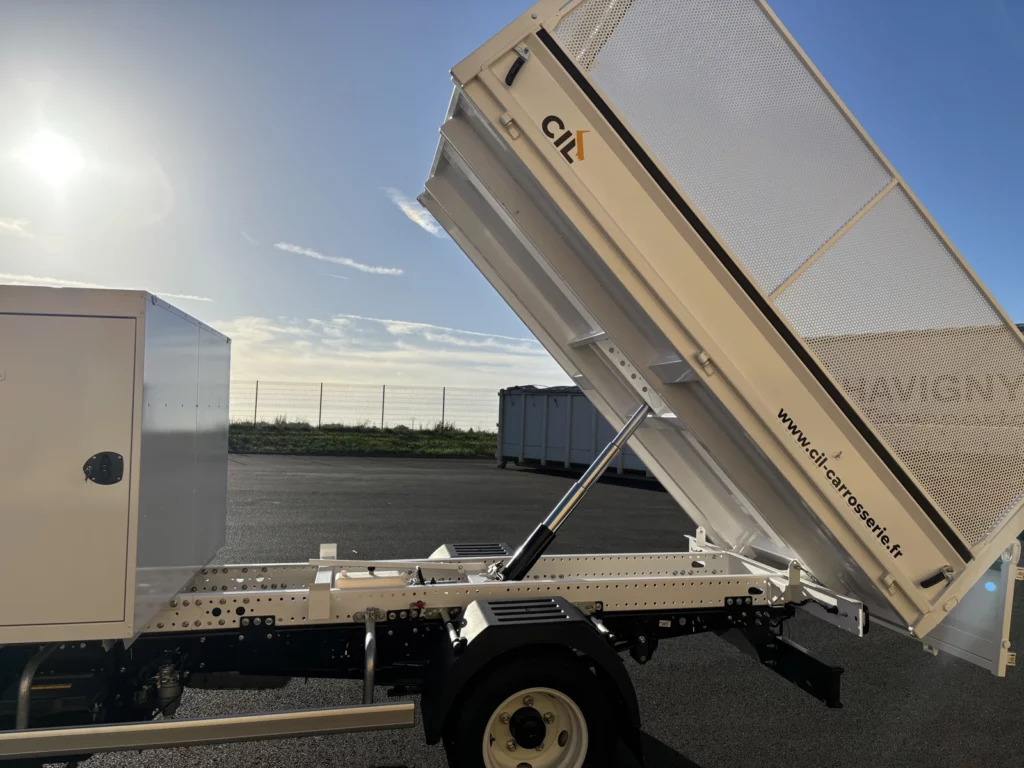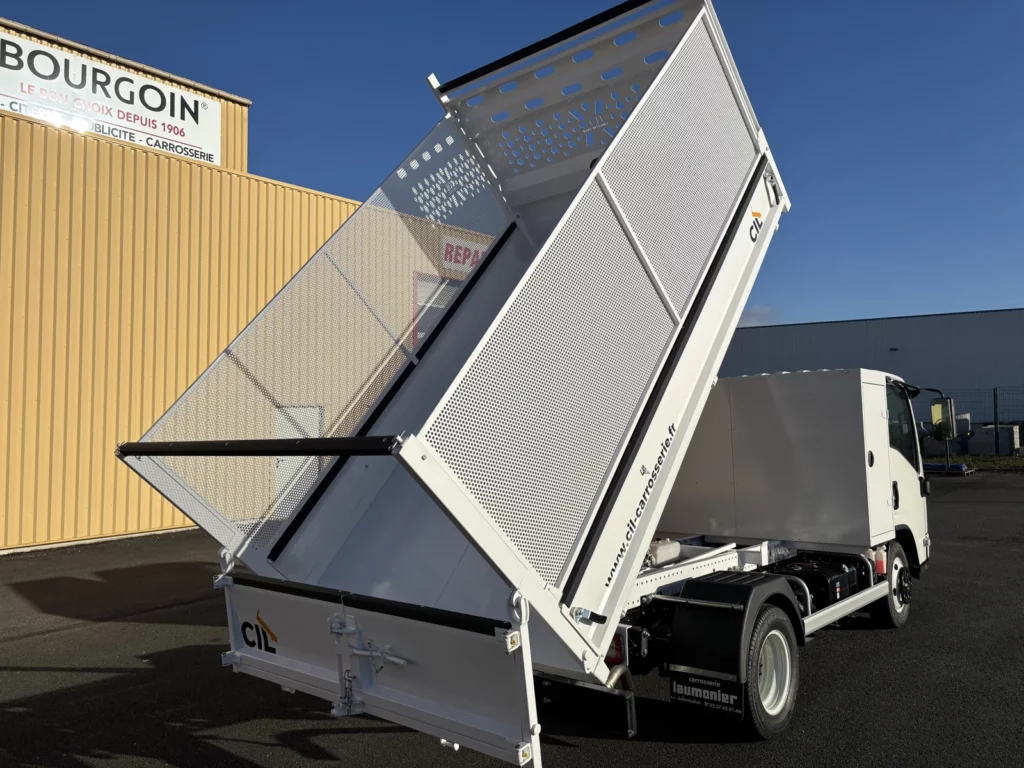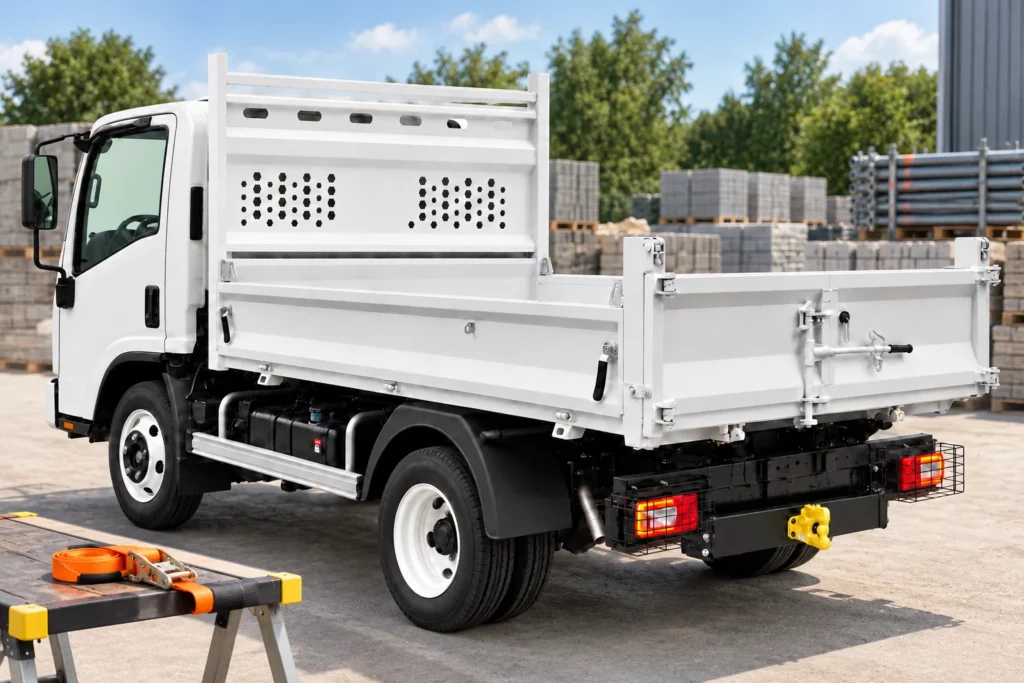
In a tipper, loose material travels in a closed body, but everything else must be held in place: pallet, cement mixer, sheets, tools, rolls of mesh. The rule is simple: the load must never cause danger or nuisance. The method, on the other hand, depends on each load. There is no number of straps that works for every pallet: you start from the weight, the shape and the anchor points available.
What the rules say
The principle is set by regulation 100 of the Road Vehicles (Construction and Use) Regulations 1986: the load « shall at all times be so secured, if necessary by physical restraint other than its own weight, and be in such a position, that neither danger nor nuisance is likely to be caused » by the load falling or being blown from the vehicle, or by any other movement of the load. Section 40A of the Road Traffic Act 1988 makes it an offence to use a vehicle when the weight, position or distribution of its load, or the way it is secured, involves a danger of injury. The government guidance on securing loads (GOV.UK) adds that sheets and nets must be secured to the vehicle so that they do not come loose while it is moving.
The law sets a result, not a recipe. It is up to the driver, and to the business organising the transport, to choose the right means: blocking, straps, net, tarpaulin.
1. Identify what needs to be held in place
Before reaching for a strap, ask yourself three questions about each item:
- How much does it weigh? A pallet of concrete blocks and a roll of geotextile do not need the same securing.
- Can it slide, tip over or roll? A tall, narrow load tips over; a pipe or a drum rolls; a smooth sheet slides.
- What happens under harsh braking? An unsecured load keeps moving towards the cab. This is the scenario to prevent first.
Loose material (sand, gravel, soil, rubble) is held in by the dropsides and the rear door. It must, however, be sheeted or covered as soon as it could blow away or spill onto the road.
2. Choose suitable anchor points
A strap is only as good as what holds it. Use the anchor points designed for load securing on your vehicle and your tipper, identified as such by the manufacturer.
A dropside, a stanchion, a ladder rack or a handle is not designed to take the force of a lashing. Hooking a strap onto a part that is not designed for it just moves the problem: under braking, that part is what gives way.
If your tipper does not have the anchor points your work requires, this is dealt with when you order, not with a makeshift hook.
3. Read and check a strap
A lashing strap made to standard BS EN 12195-2 carries a label. It shows two values that must not be confused:
| Marking | What it means | What it is used for |
|---|---|---|
| LC (lashing capacity), in daN | Maximum force the strap can withstand when pulled in a straight line | Direct lashing: the strap holds the load back |
| STF (standard tension force), in daN | Tension that remains in the strap once the ratchet is released | Frictional (top-over) lashing: the strap presses the load onto the floor |
A strap with a high LC can have a modest STF. If you are pressing a load onto the floor, it is the STF that counts.
Check the strap before each use. Discard it if the label is unreadable or missing, if the webbing is cut, frayed or burnt, or if the ratchet or hook is deformed. Never knot a strap, and do not leave it twisted. A lifting sling does not replace a lashing strap, and vice versa.
4. Block, protect and tension
The most effective securing starts with blocking:
- Place the load against the front wall or against another load whenever possible: it can no longer move forward under braking.
- Fill the gaps with suitable chocks, so that it can neither slide nor tip.
- Add an anti-slip mat under smooth loads: it increases friction and reduces the force required from the straps.
- Protect the edges with corner protectors: a strap tensioned over a sharp edge can be cut, and the protector spreads the pressure.
- Tension without crushing: the strap should hold the load, not deform it.
For load distribution itself (heavy items as low as possible, load centred across the width, no overloaded axle), see our article on distributing the load.
After a few miles, especially on a poor road or with a load that settles, stop and check the tension.
5. Net and tarpaulin: different roles
A net or a tarpaulin covers the load: it stops light items, dust or waste from blowing away. It does not hold back a heavy load. A mower, a plate compactor or a generator is blocked and strapped; the net comes on top, not instead.
A badly fastened tarpaulin becomes a hazard in itself: its straps and edges must not stick out beyond the vehicle or drag on the ground.

Tarpaulins and nets: the strength of the Bourgoin group. When it comes to sheeting and nets, CIL has a real advantage: it is part of the Bourgoin group, one of the established names in tarpaulins and technical textiles for commercial vehicle bodywork and industry since 1906. This is what allows us to offer you materials, shapes and structures of tarpaulin or net, and to adapt them fully to your tipper and to what you carry.
The checklist before you set off
- Every item that is not loose material is blocked, strapped or both.
- The straps are on designated anchor points, in good condition, with a readable label.
- The edges are protected.
- Light loose material is covered.
- Nothing sticks out, nothing drags.
- The rear door and the dropsides are locked.
Preparing a tipper suited to what you carry
If you regularly carry equipment as well as loose material, plan for it from the start: tarpaulin or net, toolboxes, tool holders. The CIL 3.5 t tipper offers these options, to be confirmed for your configuration.
Need to carry equipment as well as loose material? Describe it to CIL to discuss the equipment and its limits. Ask for a quote for my tipper project
Frequently asked questions
How many straps do you need for a pallet?
There is no universal number. It depends on the weight, the height of the pallet, the friction with the floor, the angle of the straps and the method (frictional or direct lashing). The government guidance on securing loads (GOV.UK) explains the methods, and the standard BS EN 12195-1 sets out how securing forces are calculated.
Can I hook a strap onto the dropside?
No, unless the manufacturer designates it as a lashing point. A dropside closes the body; it is not designed to take the force of a load under braking.
Does loose material have to be sheeted?
Whenever it could blow away, fall or spill onto the road, yes: this follows directly from the rule that the load must not cause danger or nuisance.
Who is responsible for securing the load?
The driver must make sure the load is safe before setting off. In a business, the government guidance on securing loads states that operators whose drivers secure loads must provide them with training, equipment and instructions.
A project? Need a  tipper? A question?
Write to us or call us: we will get back to you quickly.
Request a quote