A hydraulic tipper is maintained in two stages: quick visual checks by the user, and workshop work as set out in the manufacturer’s instructions. The aim is not to multiply tasks, but to spot wear early, so you can repair at the right time rather than deal with an emergency breakdown on site. Here is how to organise this maintenance, and keep a record of it.
Why preventive maintenance?
The Health and Safety Executive (HSE), in its guidance on the Provision and Use of Work Equipment Regulations 1998, calls for a formal system of planned preventive maintenance where the failure of safety-critical parts could put people at risk. Planned work also limits emergency repairs, carried out in a hurry. For a tradesperson, a tipper off the road on a Monday morning means a lost day on site.
What needs maintaining on a tipper:
- the hydraulic circuit: power pack, hoses, cylinder;
- the pivots: body pivot pins, cylinder base and head;
- the body: floor, dropsides, door, locking devices;
- the subframe and its mountings on the chassis;
- corrosion protection.
1. Checks before use
Before setting off, a two-minute walk round the truck is enough:
- door and dropsides closed and locked;
- body resting on its supports, properly seated;
- no traces of oil under the truck or on the power pack;
- hoses with no visible rubbing or cracking;
- no leftover load that could fall off on the road.
These checks are done from an accessible position. They need no tools and no dismantling.
2. Organise periodic checks
Beyond the daily checks, plan more thorough checks at regular intervals. How often depends on the instructions and on your use: a tipper that unloads rubble twenty times a day wears faster than one carrying green waste twice a week.
| Item checked | What to look for | Action | Date / who |
|---|---|---|---|
| Hydraulic power pack | Leaks, mounting, cables | Report any fault | |
| Oil level | As per the instructions, in the position specified | Top up as per the instructions, or workshop | |
| Hoses and fittings | Cracking, bulging, rubbing | Replacement by the workshop if needed | |
| Cylinder | Traces of oil, visible condition of the rod | Workshop if leaking or scored | |
| Pivots | Abnormal play, noise, condition of grease nipples | Greasing as per the instructions | |
| Door locks | Positive closing, play | Adjustment as per the instructions | |
| Floor and body | Deformation, cracks, welds | Workshop if cracked | |
| Subframe mountings | Visible loosening | Workshop | |
| Corrosion | Paint chips, rust | Touch-up or workshop |
This table is a framework. The intervals, products and tightening torques are those given in the instructions for your equipment: do not make them up.
3. What the instructions specify
The manufacturer’s instructions are the reference document. They specify in particular:
- the type of oil and the procedure for checking the level;
- the greasing points, the grease to use and how often;
- the tightening torques and the parts to check;
- the procedure for working under the raised body, with the mechanical support device provided.
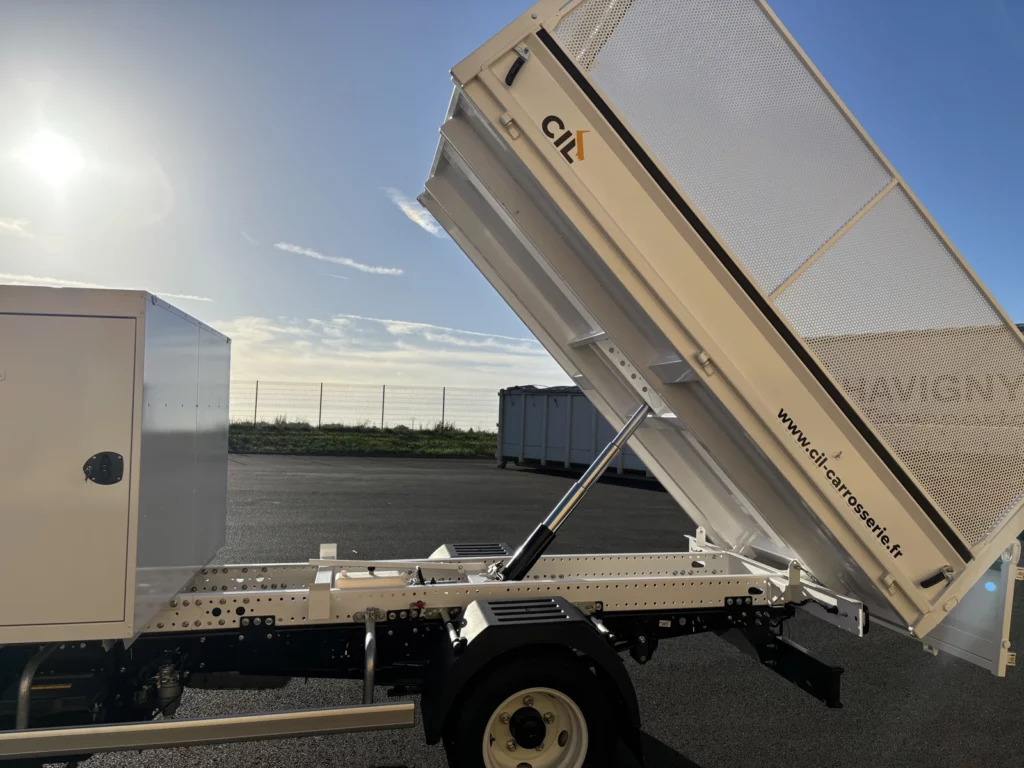
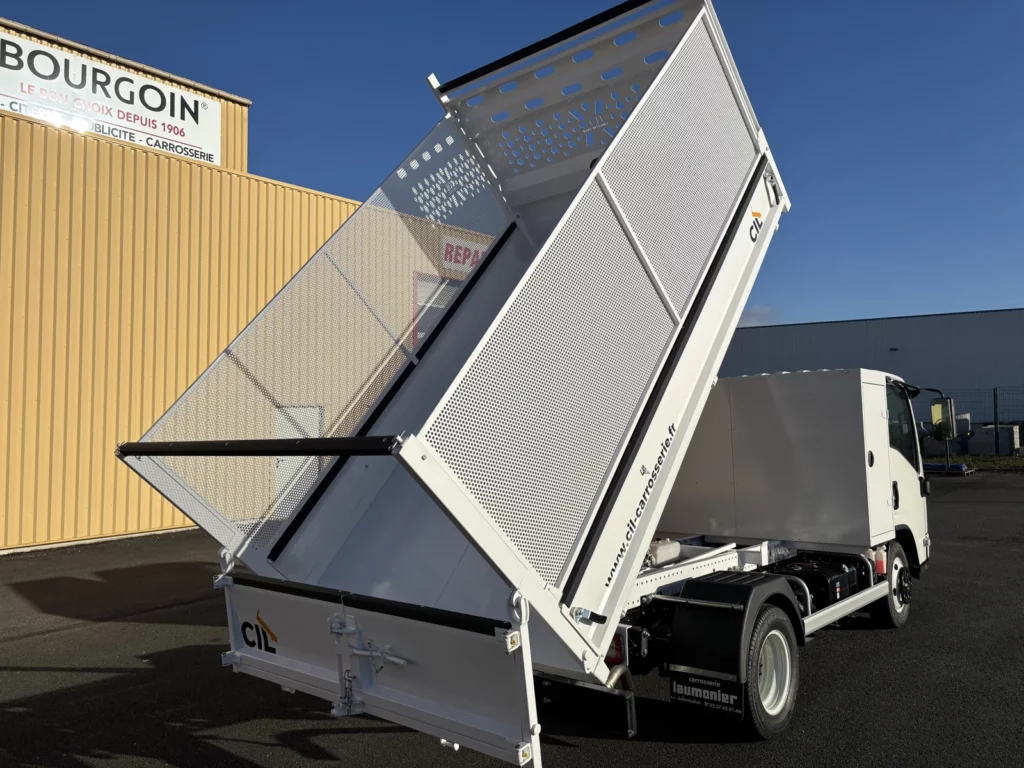
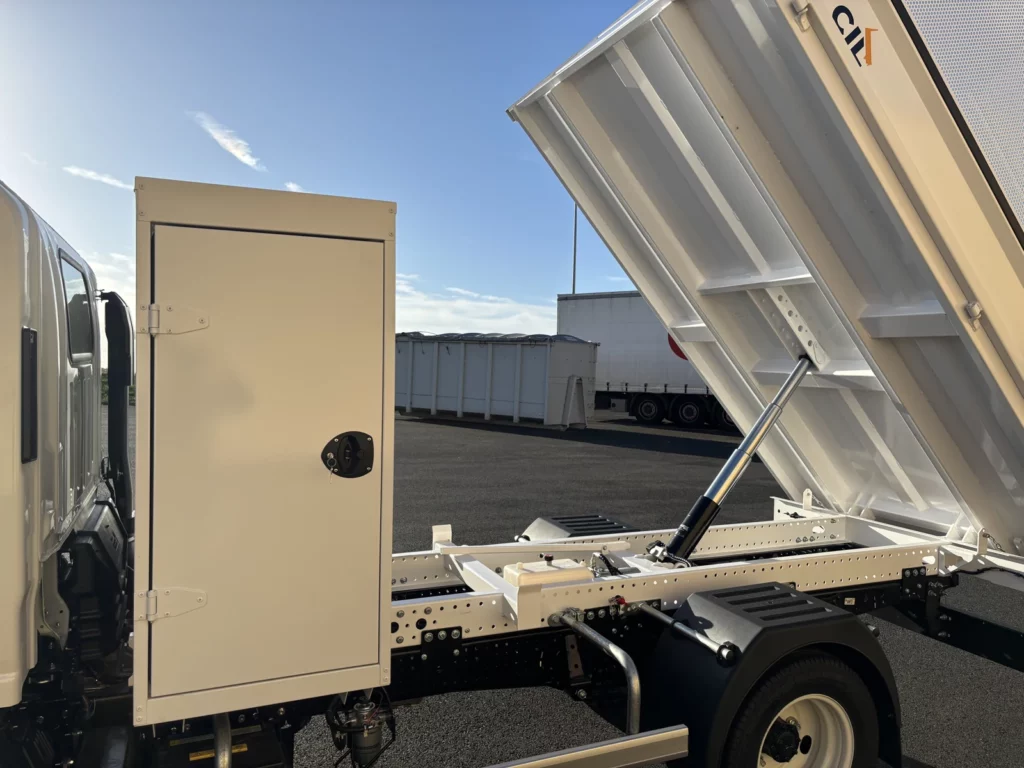
On the CIL 3.5 t tipper, the pivots use 30 mm solid pins with accessible greasing points: regular greasing is part of the planned maintenance. The body is fitted with a mechanical safety prop for working underneath.
As for statutory periodic inspections, they depend on the exact nature of the equipment and how it is used: find out what applies to your case rather than applying a general rule.
4. Any work under the raised body
This is the point that allows no exceptions: never work under a raised body that is not held by the mechanical device provided, following the procedure in the instructions, and by a competent person. The cylinder alone is not enough.
5. Report a fault
Effective maintenance also relies on feedback from the field. In a business, every user must know who to report a noise, a leak or a door that is hard to close to, and that report must be acted on. A known fault that is not dealt with is often the cause of tomorrow’s breakdown.
For the observations to make when the tipper is not working normally, see our article on the tipper that will not lift.
6. Keep a maintenance log
There is no general legal requirement to keep a maintenance log, but HSE recommends keeping a record of maintenance for high-risk equipment, and where machinery has a maintenance log, it must be kept up to date (regulation 5 of the Provision and Use of Work Equipment Regulations 1998). A detailed log records all the work done, whoever did it. A simple notebook in the glovebox is enough:
- date;
- item checked;
- what was found;
- what was done, and by whom.
This log helps the workshop understand the history of the tipper, and it makes the vehicle easier to sell.
A question about maintaining a CIL tipper? Contact CIL about my equipment And if you are preparing to buy a tipper, ask for a quote for your project.
Frequently asked questions
How often should a tipper be greased?
The interval is given in the instructions for your equipment, and it depends on how intensively it is used. A hard-working tipper is greased more often.
Is the tipper serviced at the same time as the truck?
It is convenient to combine them, but they are two separate pieces of equipment, each with its own instructions. Check that the workshop servicing the chassis also works on the tipper.
Can you change the power pack oil yourself?
Only if the instructions allow it and you have the competence. Work on the hydraulic circuit is always done with it depressurised.
Is corrosion a problem on a steel tipper?
Chipped paint leaves the steel bare. Touch up chips quickly, especially on the floor and the bottom of the dropsides, and have any corrosion affecting the structure examined.
Updated 25 October 2026
A project? Need a  tipper? A question?
Write to us or call us: we will get back to you quickly.
Request a quote